Monday, September 1, 2014

Personality Spectrum

I haven't Blogged in far, far too long...  I refer you to my last 2 Blog-Posts...you get so busy with the day-to-day activities, requirements, & hassles of life, that a lot of things end up falling by the wayside...  You have to intentionally make time for a lot of things in life.  I'm going to try hard to make time for Blogging.

I've written 2 different Blog-Posts about introverts & extroverts, & the dynamic between the two:

"Introverts & Extroverts"
http://klaamas.blogspot.com/2012/07/introverts-extroverts.html

"Caring for Introverts"
http://klaamas.blogspot.com/2013/04/caring-for-introverts.html

I have more to say on the subject--to further clarify & expand on things, & even to give a different way of looking at the terms in general.

Beyond my own Blog-Posts, there have been a lot of things going around the Internet over the last few years about introverts, & I think a lot of people have been getting the wrong impression about what we're trying to say.  The vast majority of us aren't claiming that introverts are somehow "superior" to extroverts--just that we're different, & that not enough extroverts understand that that means they need to treat us differently than they treat each other.

Yes, the world needs introverts--we introverts have strengths that society definitely needs.  But I'll readily confess, the world needs extroverts as well--extroverts definitely have strengths that society needs.  The thing we want to explain is that, as I said in my 2nd Blog-Post on the subject, "We live in an extrovert-friendly, introvert-unfriendly society, and not nearly enough extroverts understand that."  Far too often, without realizing it or even meaning to, extroverts end up inadvertantly hijacking most social interactions, & forcing everyone to play on their terms.  And you know what?  It's exhausting.

But there's another thing that far too many people don't realize--we tend to equate extroversion with being outgoing, & introversion with being reserved, but that's not always the way it works.  Being extroverted means that you are energized by social interactions, while being introverted means that social interactions are emotionally-draining.

That's not to say that introverts don't like or want social interactions--we do.  We need them.  But think of it like money:  Yes, we all wish nothing costed money, but we all understand & accept that things do, & we learn to budget ourselves financially.  And there are plenty of things that, as expensive as they are, we realize are totally worth the price.  It's the same thing with emotional energy for introverts--any & all social interactions inherently cost us emotional energy, but as long as we gain something worthwhile from the interaction, it's worth it.

Someone explained it really well in this "Guide to Understanding the Introverted"
http://iwastesomuchtime.com/on/?i=63454

The way I see it, here's how it works:  Introverts gain emotional energy from things like work, projects, reading, & imagining--sometimes all it takes is an exciting new daydream to energize us.  And we spend that energy on social interactions to gain fulfillment.  Extroverts are the complete opposite--they gain emotional energy from social interactions, & spend it on things like work & projects to gain fulfillment.  Neither one is right or wrong, better or worse--just different.

And it's vitally important to understand & accept that difference.  Too many extroverts don't understand the emotional priorities of introverts--as important & great as work & projects, careers & accomplishments are, what does any of that matter if you can't emotionally connect with other people?  But it's also important to understand that it's not a black and white issue--it's quite a spectrum, with lots of varying degrees in between (some even use the term "Ambivert" to describe those firmly between introversion & extroversion).

But it's not just a sliding scale between introversion & extroversion--at the same time, it's also a spectrum between being reserved & outgoing (which again, can be very different from being introverted or extroverted).  I think it can be illustrated well with a simple chart:


Everyone could represent themselves as a dot somewhere across this chart.  But as a culture, we tend to only recognize the upper-left & lower-right quadrants, & don't even acknowledge the other 2.  There are Reserved Extroverts--people who are very quiet, & even shy, but who are energized by social interactions (they just tend to fly under the radar).  And there are Outgoing Introverts--people who are very boistrous & unafraid to be the center of attention, but who get drained by it all relatively quickly (in essence, their social fuses burn hot but fast).

The Outgoing Extroverts usually do fine in social situations.  And the Reserved Extroverts & Outgoing Introverts do pretty well, too--their extroverted or outgoing nature usually gives them the ability to take care of themselves socially (even though they're often mistaken for being on a completely different part of the chart than they actually are).  But for the standard Reserved Introverts, it can be really hard--so many people focus on the fact that we're not outgoing, & don't seem to realize how draining social interactions can be for us.  It's not that extroverts can never be drained by social interactions--but it's a constant aspect of social interactions for us introverts.

We introverts need social interactions, & not just with "our own kind".  But extrovert interactions with introverts tend to go in one of two ways:  Either they cluelessly treat introverts the way they treat their fellow extroverts, overwhelming the introverts & leaving a negative impact--or they go too far in trying to not overwhelm introverts, & end up largely ignoring us...  But there is a happy medium.  The key is to be engaging, but not overbearing.  And the threshold between those two is very different for introverts than it is for extroverts.

It's incredibly important for everyone to realize that being introverted or extroverted does not necessarily equate being reserved or outgoing.  And even where introversion or extroversion applies, it's vitally important to understand how to interact with the other side.  And everyone needs to always keep these things in mind--because the continuous barrage of extrovert-centered social interactions is incredibly burdonsome and wearysome to us introverts.  Extroverts, we don't think we're superior to you--we need you.  So use your strengths to help us out...

"Personality has power to uplift, power to depress, power to curse, and power to bless."

Monday, October 7, 2013

Emotional Currency

There's a Blog called "But You Don't Look Sick", written by a woman with Lupus.  She uses it as a medium to spread awareness of what it's like for people with a chronic illness.  Probably her most famous post is called "The Spoon Theory":

http://www.butyoudontlooksick.com/wpress/articles/written-by-christine/the-spoon-theory/

I highly recommend reading the entire post.  But in short, to explain to her best friend what it's really like to have a chronic illness, she grabbed a bunch of spoons from off the table, handed them to her friend, & said that it's like having a finite number of "spoons" that you have to give up bit by bit through the day.  Most people have a seemingly limitless number of spoons, but for those with a chronic illness, there's a set number.  Everyday tasks are more difficult, & at some point you have to give up on doing some things so that you'll have enough "spoons" to do the more important things.

It's a really powerful analogy.  It also struck me as being a really good analogy for depression, or even for anyone's everyday emotional needs & costs.  But I don't want to hijack the analogy.  And I don't want to marginalize chronic illness---because chronic illness brings both physical and emotional pain & distress.  And there's more perspective I could give using a different analogy.  So for depression & emotions, I'm going to use the analogy of "Emotional Currency":

Every day, each of us wakes up with a bag of coins, which we use throughout the day whenever we "spend" our emotional energy on anything.  It "costs" coins to do tedious, boring, or aggrevating chores.  It "costs" coins to deal with stressful interactions with family, co-workers, customers, or other people.  It "costs" coins to have to deal with lousy traffic, crazy pets, illness, bad weather, or anything else you can think of that takes an emotional toll on you, big or small.

Most of the time, most of us start the day with a nice-sized bag of shiny gold coins, that tends to be enough to get us through the day, even if we don't end up with whole lot of coins by bedtime.  But sometimes things don't go so smoothly.  Sometimes you find yourself having to spend a whole lot more coins than normal.  Sometimes more stresses, more frustrations, or more negative factors suddenly means you have a lot more emotional "errands" to run that day, leaving you with fewer coins at the end of the day than normal...

Sometimes you get the normal "amount" of stresses, but they're a lot more stressful, a lot more frustrating, or a lot more difficult---it's like the price has gone up, & you have to spend a lot more to get the same result.  Sometimes nothing external is different, but suddenly your ability to put emotional energy into things has  been diminished---it's like inflation has happened, or like your currency has been devalued, & instead of shiny gold coins, you've got a bag of less-shiny silver coins, or even dull copper ones.

And you don't always start out with the same amount of coins each day.  One day you might wake up with 2 bags' worth of coins---or only half a bag's worth of coins.  This can be affected by the previous day or days.  If things have been going well---if you've been "investing" your emotional currency well, & been getting good returns---you find yourself with a lot more than you had before.  If this happens very often, you can start  "saving up for the future".

But if things go badly---if you invest poorly, if you waste your previous profits, if prices go up, or if inflation or devaluing happens, suddenly you have a lot fewer coins to get through the day with.  Sometimes you can "take out a loan", borrowing money from the next day or two, to get yourself through today---but that just means that, barring any sudden & unexpected gains, you'll just have that much less to spend tomorrow.  And sometimes you even get emotionally mugged.  A sudden, huge, horrible circumstance comes out of nowhere & forces you to deal with it---forces you to give up a giant handful of coins to get through it safely.  And you find yourself suddenly much poorer than you were before, for no good reason...

Now, imagine what it's like for somone who suffers from chronic depression.  Whether it's medical "clinical depression" that can be medicated, someone who's life is a complete disaster, or even just someone who, for whatever reason or reasons, is constatly finding themselves down & discouraged, it all ends up pretty much the same.  All those lousy circumstances I just described?  For depressed people, it's like that all the time.  All the time.  People like that rarely go about their day of "spending" normally.  They often don't wake up with a full bag of coins.  Or they often don't have gold coins.  Or they often find the prices are always higher for them.  Everything is harder.  And it's often not ever clear why, even to them.  It's just harder.

Positive thinking can only taking you so far.  Telling people to "cheer up" or that "things will get better" is like saying "money isn't everything" or "you'll find a better job soon".  They may be true, but that's hardly the point.  It doesn't affect how things are now.  And there's no guarantee of progress or improvement.  Things don't just magically get better---things have to be done to change circumstances.  And when your efforts aren't working, the though of things never improving is one of the most discouraging things imaginable...

And it feels worse when things seem to be going well for so many people around them.  It's especially worse when people make a point of saying how amazing things are going for them.  When people go on about "I'm loving life, things are going so great, life is amazing...", those who suffer from depression are thinking "That's really great for you, but you know what?  Quit bragging...some of us aren't so lucky..."  It's like someone is going on about "My business is going so well, I'm getting all kinds of sales, I'm making so much money, & I get to buy all these cool, fancy things, it's awesome!"  That's really great for you, but you know what?  Quit bragging...some of us aren't so lucky...

Some people aren't even "getting by", emotionally.  Some people are constantly finding themself short on coins.  Some people have to spend so much, & get so few results.  Some people have dig to the bottom of their bag to find coins to pay for things.  Sometimes only halfway through the day, they find themselves near-broke, desperately clinging to their last coin, absolutely terrified that someone will ask or force them to give it up before they get their bag refilled the next day.  And once they're out of coins, the next "cost" they're forced to deal with is the breaking point.  They can't afford it.  No matter how much they need it, they can't buy it.  All they can do is break down, collapse, melt...and that will definately severely affect either their starting amount or value the next day, or the prices the next day...or both...

Some people just can't catch a break with emotional currency.  Whatever the reason they're depressed, everything is harder & more taxing.  They're constantly finding themselves short on coins.  They're constantly having to let things (even important things) fall by the wayside, so they can spend their coins on the most important things---which is often simple emotional survival.  And helping them is tricky to do.  You very often can't just offer them some of your coins---no one wants anyone's pity...no one wants to be anyone's charity-case...it just makes them feel pathetic & incapable...  You can't give them your coins, & you can't spend your coins for them.

One option is that you can spend your coins on them.  Those who are constantly strapped for coins understand best how much it means when someone chooses to spend their coins on them instead of on something else.  Another option is to help them spend or invest their coins well.  Help them make sure that the things they're spending their energy on don't end up wasted---or end up draining them of even more coins...  Sometimes the best thing to do is simply understand when they can't spend coins on things with the rest of you---understand when people don't have the emotional currency to deal with something right now.  But never just "accept" that someone is simply emotionally "poorer" than you, & that "that's just the way it is".  Because that doesn't do anyone any good...

"That's the thing about depression: A human being can survive almost anything, as long as she sees the end in sight.  But depression is so insidious, and it compounds daily, that it's impossible to ever see the end.  The fog is like a cage without a key."

Tuesday, May 21, 2013

Balance of Life

I've been thinking lately about all the elements of our lives that we struggle to deal with.  We have all kinds of issues, all kinds of aspects of our selves, our homes, our jobs, our families & friends, & every other part of our lives, that we have to find some way of coordinating with all the others.  In the end, it's about balancing all the elements of our lives with each other.  I've seen it illustrated as a pie-chart, with 5 equal pieces:

Spiritual, Intellectual, Social, Emotional, & Physical.

(Some people describe a 6 or 7-part pie-chart, with Occupational &/or Environmental added on, but I think those can be folded into Intellectual & Physical respectively.)

There's no proper order to the 5 areas---they're all equally important aspects of lives in their own ways.  And it's important that we fulfill each of those areas in our lives.  If you're lacking or overextending yourself in any of those areas, your life is going to be out of balance.  Things aren't going to be completely "going well"---you're going to feel like you're missing something, or aren't completely content or fulfilled in life.  And if things are out of balance enough, you're going to feel very stressed & unhappy.

But I recently looked at this idea of "balance" more literally.  Instead of a pie-chart, think of a set of balance-scales, with shallow dishes hanging off of a central point.  But instead of a standard 2-part scale, think of a 5-part scale---5 shallow dishes, each hanging off of the ends of a 5-branched star, with the center balanced on the end of a central point.

Each of us fills these 5 dishes with marbles---the various elements of our daily lives.  It's vitally important to keep the 5 areas in balance---if you put too many (or not enough) marbles in any given dish or dishes, it's going to unbalance the entire set of scales too far in one direction.  If it's unbalanced enough, marbles are going to start dumping out of at least one of the dishes.  We can only handle so many things (especially when other areas of our lives are lacking), & ultimately the things we can't handle will just fall by the wayside.

But if the imbalance is extreme or sudden enough, it can have outright volatile results.  If you suddenly add a bunch of marbles, remove a bunch of marbles, or too many marbles dump out from an imbalance, the entire scale swifly shifts in the other direction, sending all the marbles into motion, rolling & moving around, & likely dumping out randomly & unstably in who knows what direction.  You've quite literally "lost your marbles".  When things get too far unbalanced, it can send your life into chaos, & suddenly you can handle very little until you get the bare necessities under control.

But there's another way of looking at things to consider---we can't always just "add marbles" by making efforts in each of the 5 areas.  Sometimes we put in lots of effort, & it doesn't amount to much.  Sometimes we're going about it the wrong way, sometimes we're doing things at the wrong time or in the wrong place, sometimes things just take a while to take effect, etc.  Sometimes we don't know how to add more marbles to a particular area.  And sometimes we need other people to add marbles for us.

Sometimes, no matter how much we want to add marbles to any given dish or dishes, it just doesn't happen.  And when any dish is empty or close thereto, you can only add a few marbles into any of the other dishes before it sets things out of balance.  No matter how much you want or need to increase the quality & content of any area of your life, you're not going to be able to take on or handle more than just a little if you're severely lacking in any one area.

Every one of us needs to "take stock of our lives" on a regular basis, looking at how we're doing at fulfilling & maintaining the balance in our lives.  We need to learn how to recognize when we're lacking, how to change it, & when we're taking on too much.  We also need to learn to reach out to others---when we can't figure out how to keep our lives in balance, & when we need others to help.  And each of us needs to be willing to help others in balancing their lives---whether in simple support, suggestions, or advice, or in directly adding to their balance where they can't do it themselves.

If you keep your life in balance, it's amazing how much you can handle---just as an actual set of scales is limited only by it's own breaking-strength, a well-balanced life is limited only by time.  When you stay in balance, you can lead an incredibly rich & fulfilling life.  But when you're out of balance, your life can be surprisingly barren...  So what are you doing to keep your own life in balance, & help balance the lives of the people you care about?

"Happiness is not a matter of intensity, but of balance, order, rhythm, and harmony."

Wednesday, April 10, 2013

Caring for Introverts

This past summer, I wrote an important Blog-post called "Introverts & Extroverts".  This post is a follow-up to that---I hope to expand on what I said, & give further insight into how to interact with introverts.

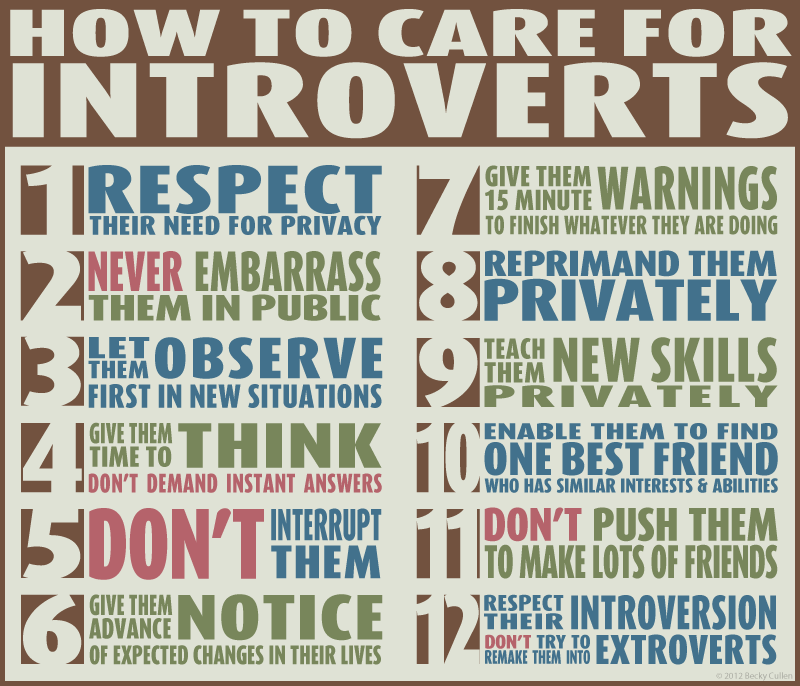
In that Blog-post, I posted a link to an article titled "10 Myths About Introverts".  Read it.  Then read it again.  And again.  Memorize the things it talks about.  And not just the 10 main points---the extrapolatory paragraphs are absolutely filled with little treasures about introverts' thoughts, feelings, & behaviors.  It's an amazing article.  Later in that Blog-post, I posted another link to an image titled "How to Care for Introverts".  It's also incredibly insightful---and incredibly simple.

I've seen people post links to a similar image titled "How to Care for Extroverts".  I don't disagree with the points that image makes, but I do not put much thought into them---because comparatively, extroverts don't need much caring for.  They're quite capable of caring for themselves, and for each other.  And even when they're not being cared for, they're much more capable of dealing with it than introverts are.  We live in an extrovert-friendly, introvert-unfriendly society, and not nearly enough extroverts understand that.

So here are some more of my thoughts on caring for introverts:

As introverts, we have a comfort-zone of interactions & activities, & a bubble of personal-space.  It's not that we never want to come out of our comfort-zone, or that we never want to let anyone into our bubble---but we don't want do be dragged out of our comfort-zone, or have our bubble invaded.  Essentially, what we want is for people to knock on the door, wait for us to respond, & then politely ask if we'd like to come out or if they can come in.  And you know what?  Sometimes the answer is "no".  But that rarely means "never"---it ususally means "not right now".

When it comes to our comfort-zone of interactions & activities, sometimes we need to sit by the fence & watch for a while before we feel comfortable coming out.  And even then, sometimes we only feel like coming a little ways out, so we can jump right back into our comfort-zone as soon as we start feeling uncomfortable.  Let us do this, & we'll slowly get more & more comfortable, & be more willing to start coming further out of our comfort-zone, & for longer periods of time.  But rush us, or try to push us into something we're not comfortable with, & it's not going to happen---& it'll only delay our willingness to try again.

When it comes to our bubble of personal-space, we need to feel comfortable with someone as a person before we're willing to let them into our bubble.  We need to spend time in close proximity with them on a regular basis.  And even once we're willing to let them in, it's not an "all or nothing" deal.  Start with simple things like a handshake, a high-five, or a fist-bump (as silly & superficial as those might seem).  From there, things like a pat on the back or a quick shoulder-side-hug.  And so on.  But rush us, or try to push us into accepting too much physical contact (or even just too close a proximity), & you'll make us incredibly uncomfortable---& it'll only make us far more hesitant to allow it in the future.

But the final (& possibly most important) thing to understand regarding interactions with introverts---whether physical, conversational, or activity-wise--- is that you have to ask.  You have to try.  You have to make the effort.  You can't expect the introverts to do it all.  We set the tone & pace of things, yes, but we still need to know that the extroverts want those interactions with us.  As I said in my previous Blog-post, "How can you expect an introvert to do something if the extroverts don't seem willing to do it?"  Don't be constantly trying to pressure us into things, but if you don't even offer, we certainly won't.

"Introvert conversations are like jazz, where each player gets to solo for a nice stretch before the other player comes in and does his solo.  And like jazz, once we get going, we can play all night.  Extrovert conversations are more like tennis matches, where thoughts are batted back and forth, and players need to be ready to respond.  Introverts get winded pretty quickly."

Monday, March 25, 2013

The "Choice" of Happiness

Few things make my blood boil more than hearing people say that "happiness is a choice".  We certainly have a great deal of influence over our own happiness, but there's a lot more to it than that, & I'd like to explain why.

First off, I fully concede that you can't be happy without a positive attitude.  Those who are pessimistic at heart will always find something to complain about---there is, after all, an endless supply of faults & sorrow in this world.  You'll never be able to rise above all the negative without being able to think positive.

Second, I don't want to get into an esoteric, philosophical discussion of what happiness "is".  We all have moments of happiness, but while uninterupted bliss is completely unrealistic, there are those who are truly happy in life as a whole---they're in a place where most things are going fairly well, & they have enough good in their lives to outweigh & overcome the bad.

But you can't just "decide" to be happy, & then you'll just be happy.  Do you think Christ was happy while suffering in the Garden of Gethsemane & on the Cross?  Do you think Job was happy after having lost his home, possessions, family, health, & nearly his life?  Do you think they could have been happy during those times?  Those may be extreme examples, but they're perfectly valid.  There are circumstances in this world that you can prevent you from being happy, at least for a time.

Here are a number of situations that can prevent happiness in one's life:  You can't be happy if you're suffering from actual, full-blown depression.  You can't be happy if you're in severe, constant pain.  You can't be happy if you're not living righteously.  You can't be happy if you don't have close, emotional relationships with others.  You can't be happy if you don't have structure, purpose, & direction in life.  And many other things...

It's important to point out that we all have the power to act---to do things to change the negative circumstances in our lives, to enable ourselves to be happy.  But happiness can't just be dispensed at the push of a button by "deciding" do be happy.  We have control over many circumstances that affect our emotions, but when we're feeling an emotion, in that moment, we have no control over feeling that way.  We can control how we react to our emotions, & in the long term that can affect our future emotions---but in the moment, you can't control how you feel.

Most immediately, everyone needs to understand that sometimes we need to not be happy.  When something really bad happens to us, when someone close to us dies, or when we suffer some great loss or pain, we feel very unhappy---and we need to feel that unhappiness.  We can't just ignore emotions we don't want to feel (which is the subject of another upcoming Blog-post...).  Even the Bible agrees with this:  "To every thing there is a season, and a time to every purpose under the heaven . .  . A time to weep, and a time to laugh; a time to mourn, and a time to dance;"  ---Ecclesiastes 3:1&4.  We shouldn't unduly dwell on sadness, but to repress or suppress feelings of unhappiness when they come upon us is incredibly emotionally unhealthy, & even damaging.  We need to rise above unhappiness, but we need to go through it first.

And often that takes time.  You can't just have a "good cry" for a few minutes, hours, or days just to "get it out of your system".  Every situation, & every person, is different---we all have to deal with sadness, depression, & unhappiness in our own way, & in our own time.  Some people are capable of doing it fairly quickly---good for them.  But others aren't so lucky.  And it's not always because they're "not handling it well".  Don't judge someone's emotional state when you aren't them, & when you don't know what they've gone through or are going through now.

But the thing I want to stress the most is the message you send someone when you tell them that "happiness is a choice":  No matter what horrible circumstances they're in, no matter what terrible pain they're going through, no matter how much they don't want to feel as unhappy as they are, you're telling them that their unhappiness is completely their own fault.  How do you think THAT makes them feel???  It only makes them feel worse---you're shaming them into thinking that all the emotional pain they're going through means nothing, & that they are solely to blame.  That's why it makes me so angry to hear people say that "happiness is a choice".  Few things hurt so deeply to hear for those who are unhappy.

We have control over our attitudes, & we should adopt a positive one.  We have control over our actions, & how we thereby react to our emotions & situations.  But to tell an unhappy person that "happiness is a choice" is nothing less than to spit in their face!  So when someone you care about is really going through something, instead of coldly dismissing their pain, show them some real empathy & support.  And most of all, do what you can (as far as they're comfortable with) to help them go through their pain---because few things are as terrible as not only being miserable, but being alone in your misery.

"Action may not always bring happiness; but there is no happiness without action."

Sunday, March 17, 2013

Who Reads My Blog? You Should Read My Blog.

Who reads my Blog?  You should read my Blog.

I haven't gotten any comments on my posts in quite a while.  I guess it doesn't help that I don't post very often, or at predictable times or invervals.  But this Blog is actually pretty important to me---it's a venue to get some things out of my system that I otherwise usually can't.  I posted incredibly frequently early on (once a week for 4 months!), then got really bad...I just keep forgetting...  But I've been improving.  And I do have a number of ideas for posts, including several important ones that I intend to do very soon.

My Blog is kind of interesting...  A handful of posts are about random things that aren't all that important in retrospect.  A handful are kind of emo...I guess I just needed to vent at the time...  And a handful are about girls---some may think some of those posts to be somewhat harsh or angry, but I stand by them (& my latest experience in dating only serves to strengthen those views...).

But in the end, about half of my Blog-posts are things I feel very strongly about, & I feel are really a good read---if nothing else, for people to understand me better.  In particular, 3 of my more "recent" posts (from this past Spring & Summer) are 3 of the most important posts I've ever done...

I fully intend to post more frequently in the future, & I'd really appreciate it if people would give me feedback---whether in the Blog's official Comments section, on the Facebook post where I announce each new Blog-post, or in private.

I'm not overly careful of who I let see my Blog-posts.  First of all, as someone once said, "If you want something to stay private, don't put it on the Internet." ;)  And second, there's plenty of people that I just don't expect to care enough to read my Blog (there's plenty of people that I know, that I like well enough & all, but I'm just not close enough to them to care enough to read theirs...).

But if you value me as anything more than a casual friend, you should read my Blog.  Really.

"There is nothing to writing.  All you do is sit down at a typewriter and bleed."

Monday, November 5, 2012

Political Chaos

The Big Election is tomorrow, & I'm dreading the aftermath---regarding whoever gets elected, how people from the losing side will react, & the direction this country is going.

Talking politics is like talking religion:  In both subjects, people are very set in their views, & they are not interested in changing them...  They hear something they don't agree with, & they shut their eyes & cover their ears, & say "Nope, that's not something I believe, I'm not gonna listen to it"...  They turn it into a black & white "us vs. them" situation...  They interpret anything someone from "the other side" says in the worst way possible...  They villify "the other side", & always presume ill intent...  Politics & religion---our civil liberties & the proper role of government, and moral right & wrong and the fate of our eternal souls---are probably the 2 most important subjects that people could discuss, yet they're the 2 subjects that people tend to make themselves the least capable of discussing civilly & intelligently.

Here are my thoughts on this Election Season & tomorrow's Election:

1- Villification of the Opposition
2- The Role of Government
3- The Outcome


1- Villification of the Opposition:

More than I've  ever seen before, people outright villify "the other side".  But I'm not talking about the candidates doing the villifying---they've always done that.  More than I've ever seen before, so many average citizens talk about how the "other" candidate is a flagrant liar & a horrible person.  Some think both are.  I've seen most of the "evidence" for both, & most of it can largely be dismissed as presuming ill intent, taking things out of context, or things just not going how the candidate intended.  I think both candidates are quite wrong about a lot of things, but I haven't seen any concrete, would-hold-up-in-a-court-of-law evidence that they're flagrant liars.

It's naive to think there isn't corruption in politics, but the thing is, there are plenty of politicians who aren't liars---they've simply built themselves on flawed principles.  And to reconcile themselves with the problems that these faulty foundations create, they've developed a warped view of things.  They've adopted beliefs like "the ends justify the means", or that certain things apply in one circumstance & not another (when from a more objective point of view they apply to both), or that it's okay for the "good guys" to have unchecked power, or that it's okay to force the "right" decision on other people, or lots of other things.  Opponents see the problems in a politician's views, & interpret ill intent & deception, when far too often, the politician is simply wrong.

And this becomes a huge problem when you attempt to discuss politics with others.  If you say "The politician you support is a liar", you're implying that the politician they support is a horrible person.  And by extension, you're implying that anyone who supports that politican is a liar & a horrible person, or at the very least "ignorant" & "foolish".  When you start sending out insultive messages like that, people close their minds, become combatative, & for both people it simply becomes a battle to "defeat" the other person, rather than about coming to a better understanding of the truth.  Which approach would make someone more willing to engage in intelligent, civil, open-minded discussion:  "The politician you support is a liar", or "I think that the politician you support is wrong"?

And the thing is, what trait is shared by both liars, & those who are simply wrong?  They're both wrong.  And it's all-around much easier to convince someone that a politican is wrong than it is to convince someone that a politician is a liar.   Even if the politician is a liar, it's often very difficult to truly prove, & a combative, offensive approach only hardens feelings & deepens narrow-mindedness---on both sides.   Combativeness begets combativeness, & civility begets civility.  That's the only way we can get anywhere.


2- The Role of Government:

So many people, on both sides of the political divide, seem to think that the government's job is to force an "ideal" situation on everyone.  But that is the exact opposite of what government in a free society is meant to do.  And both sides have it wrong in different ways.

To the Political Left, I say this:  It's not the government's job to do everything for us.  It's not the government's job to give everything to us.  It's not the government's job to provide all of us with money, food, clothing, shelter, health care, education, & employment.  The government's job is to ensure that every one of us has the safety & freedom to obtain all of those things for ourselves.

To the Political Right, I say this:  It's not the government's job to force people to do the right thing.  It's not the government's job to police morality.  It's not the government's job to impose moral, political, or economic ideals on others, at home or abroad.  The government's job is to maintain an environment where individual rights are upheld, and where justice & recompense are enacted when individual rights are violated.

Government in a free society does not exist to force an "ideal" situation on everyone---government in a free society exists to secure individual rights.  The United States is not a pure Democracy---it is a Democratic Republic.  A Republic exists to guarantee the rights of every individual.  And that includes the right to choose.  Yet so many people are willing to try to take away the rights of others in an attempt to force their idea of utopia on everyone.  You can't force people to do the right thing, or not to do the wrong thing.  You can't legislate morality, or equality.  Government cannot---repeat, cannot---create utopia.  Only families, communities, & societies can.  Mistakes and wrongdoings should bring consequences, which consequences should be known beforehand.  But people need the freedom to choose.  And force is the opposite of freedom.


3- The Outcome:

Just because you support either of the primary Presidential Candidates, that doesn't mean I think you're a bad person.  It doesn't mean I think you're stupid.  It means I think you're wrong---very wrong.  Both candidates, whether either or both of them are liars or not, are simply wrong.  They're trying to force ideal situations on both the U.S. citizenry, & on the world populace, & they're willing to take away people's individual rights in their attempts to do so.  In regards to the military, health care, the economy, jobs, & virtually every other major issue, they're far more alike than they are different.  They've fallen under the alluring deception that government can solve all our problems, when in reality, government intrusion has enhanced most of those problems.

To those who will vote for either of the primary Presidential Candidates because you truly believe in their methods & ideologies, I once again say this:  Force is the opposite of Freedom.

To those who will vote for either of the primary Presidential Candidates simply out of fear of the "lesser of two evils" winning, I say this:  The broken, 2-party system will never die if we continue to support it.

And to all those who will vote for either of the primary Presidential Candidates for any reason, I simply say this (courtesy of Despair.com, & w/a hat-tip to Ghostbusters):


A little melodramatic?  Sure.  But no less poignant...  Either of the 2 primary Presidential Candidates will take this country further down the wrong road, so it really doesn't make much of a difference which one we vote for.  OR...we could all, for once, vote for a candidate who would institute actual change for the better...

          LIBERTY  OVER  LEGISLATION
                COME  AND  JOIN  THE 


                    RON  PAUL  2012

"When the government's boot is on your throat, whether it is a left boot or a right, is of no consequence."

Monday, July 2, 2012

Introverts & Extroverts

This post has also been a long time coming...

It's my experience that most extroverts royally suck at dealing with introverts.  Seriously, the vast majority of them get a freaking Grade-F on the subject...  As an introvert myself, I feel compelled to come right out & say to the extroverts of the world:  "You're doin' it wrong"---but I also want to be more constructive & actually explain the differences between us.

The first problem is that far too many of you extroverts have the wrong idea about introverts---you think we're unfriendly or unsocial.  There certainly are plenty of anti-social people, who would pretty much all be classified as introverts, but that's not healthy.  Humans are social creatures by nature---we crave human connection, & if someone's come to the point where they've largely given up on that, they've clearly had far too many negative experiences, & need more positive, quality social experiences.  No human being can ever be emotionally healthy or satisfied without close, personal relationships with other people.

I'm an introvert---but I'm a very social introvert.  I like being around people.  Quite a lot, actually.  Most things I'd prefer to do with people than alone (& even then, most of the things I'll do alone would be more enjoyable with people).   Everyone needs to be alone at times, & maybe introverts moreso than extroverts. But just because someone's an introvert doesn't mean they're anti-social---it just means that they're not socially adept, not exceptionally socially skilled, not socially confident, not very good at conversation, etc.

I recently saw a short article that does very well in describing the subject:

"10 Myths About Introverts"
http://www.carlkingdom.com/10-myths-about-introverts

Introverts really are social people, generally, but it doesn't come as naturally, or flow as easily, as it does for extroverts.  We need an actual "reason" to socialize---a particular topic of conversation, a specific activity, etc.---not just "open socialization", like a stereotypical party or mixer.  It's incredibly difficult as an introvert to just walk up to a random person for no apparent reason & start a conversation right off the cuff.  For all you extroverts reading this, scratching your heads, & wondering "Why is that so hard?", I'll tell you:  We don't know!  It just is!  Introverts simply inherently think & feel differently than extroverts, & in this aspect maybe we're "slower", "behind", or "less capable" than extroverts, but that's just the way we are.

That leads to the next issue:  So many extroverts seem to think that introverts just need to learn to completely come out of our shells & become extroverts.  Let me make this abundantly clear:  It ain't gonna happen.  Like I just said, introverts simply inherently think & feel differently than extroverts.  Yes, we need to learn to branch out & step out of our comfort zones at times, but you can't expect us to just become "one of you"---being an introvert is a different personality-type, a fundamental part of our being that can't be fundamentally altered.

But ultimately, whether they realize all this or not, so many extroverts simply shake their heads, throw up their hands, & say to themselves, "I just don't understand introverted people..."  But you know what?  You don't have to understand us to interact with us properly.  I don't understand extroverts---the idea of just walking up to a total stranger at a party, introducing myself, & starting up a conversation simply terrifies me, & I don't see how you people can handle it...  But even though I don't understand it, I accept that you're comfortable with it, & I approach social situations with extroverts knowing how they're going to behave.  Actually understanding it might help more, but simply knowing & accepting the type of person someone is still helps a lot.

The problem is that so many extroverts, because you don't "get" how introverts think, just sort of assume that you should just interact with us like you do with each other, & that we'll eventually "catch up" or something.  But it doesn't work that way...  As I said, being an introvert is a different personality-type, & treating us like extroverts is just asking for trouble.  If there's too much going on, if we get "left behind" socially, if someone's too socially forward, if we're put on the spot, or if we get embarrassed, we don't adapt quickly or easily---we shut down.  And if the situation makes us in any way uncomfortable, we even put up walls, & feel the compulsion to extract ourselves from the situation as soon as possible.  Maybe not being able to handle awkwardness or uncomfortableness is a failing on our part---but if you just toss someone into the deep end of the pool to teach them how to swim, they're just going to drown...

After all this talk about how not to deal with introverts, it's important to specifically point out how people should deal with introverts.  A picture that's been making the rounds on the internet this year explains it pretty well:

"How to Care for Introverts"
http://25.media.tumblr.com/tumblr_lz1mrdBaW31qk20afo1_r2_1280.png


Extroverts, you need to be very courteous & respectful of us introverts.  And you need to be patient with us, & even help us out a little.  Be willing to initiate interactions, because sometimes we're just not sure how.  You might think that you're prone to reaching out to us, but you're really not---we tend to be invisible to you, while you interact with each other.  With that in mind, always, always remember my last Blog-Post---only interact with someone because you actually want to, not out of some over-the-top attempt to be "nice"...  But if you really do want to interact with an introvert, you can't leave it all on us.  How can you expect an introvert to do something if the extroverts don't seem willing to do it?

And interacting with someone means eventually talking about more than small-talk.  Basic pleasantries are "nice", but at some point, if that's all your interactions with someone entail, it's not very meaningful...  If you truly want to get to know an introvert, then actually put in the effort to get to know us.  But remember:  We're fairly socially "hesitant"...we're not prone to talking about personal things...we keep a lot close to the vest...we need to know that someone can be trusted...  At each step of the way, we need to feel accepted as person.  So getting to know us takes time.  And ultimately, the only reason the differences between introverts & extroverts, & our interactions with each other, really matter is in regards to friendship.  So quit making friendshipping so hard for us...


I think the best thing for extroverts to do in interacting with introverts is to put yourselves in our shoes.  But not in the way of "What would I, an extrovert, do in the situation that this introvert is in?"  That completely destroys the purpose.  You need to ask yourselves, "What would I do if I were them?  What would I do in this situation if I were an introverted person?  How can I expect an introverted person to act?"  Just because you don't understand how we think & feel doesn't mean you can't accept it, & treat us accordingly.  And you need to.

"A friend is one that knows you as you are, understands where you have been, accepts what you have become, and still, gently allows you to grow."

Monday, June 18, 2012

The Crime of Pity

This post has been a long time coming...  It's something I feel incredibly strong about, but have never taken the time to think out in an organized way to put into writing...

I want to speak to all the extroverted people out there on the subject of pity.  So many of you outgoing, confident, popular, attractive, eloquent, or otherwise socially "okay" people quite often have a way of looking at people who are...less socially okay...  You see people who are quiet or nervous, people who seem to stand on the edge of the social scene, people who are generally seen as unattractive, people who have a hard time with dating...people who aren't as socially "grounded" as you are.  And you feel sorry for them.  You feel the need to reach out to them---not in an ordinary, be-accepting-&-fellowship-&-include-everyone kind of reaching out, but something much more than that.  You feel the need to give those socially less-grounded people what you think they're lacking.  Not because you actually want that kind of interaction or relationship with them---but because you feel bad for them.  You feel the urge to offer certain social interactions to them, so they'll have it, just like everyone else.  You think you're doing them a favor.

But you're not.  You're insulting them.

Some people might not have any problem with the idea of pity---but that all depends on what concept we're talking about.  If you had to make a distinction between "sympathy" & "pity", what would it be?  If you were to define "sympathy" as a positive thing, & "pity" as a negative thing, what do you think the difference would be?  I do make such a distinction, & for me it's this:  Sympathy is feeling bad with someone, while pity is feeling bad down at someone.  Not in a disdainful, "I'm a better person than you" kind of way, but in an "Oh, you poor thing..." kind of way.  Who wants anyone to look at them like that?  Everyone wants sympathy when they're going through a hard time, but no one wants pity...

When you offer someone pity, of any kind, in any way, to any extent---a pity conversation, a pity "friendship", a pity date, a pity kiss---you're telling them "I think you're so pathetic & incapable, that you can't get this kind of social interaction on you're own.  So I'm going to lower & debase myself to throw you a bone---it's not real, but I'm going to masquerade it as the real thing, so that you'll feel better."  It's demeaning, it's degrading, it's insulting.

Again, pity isn't looking down on someone condescendingly---it's thinking less of someone socially.  But because so many of you outgoing people don't look at the less socially-capable people with actual unkindness, you seem to think that pity is a good thing.  You think you're being nice.  You think you're helping someone out.  But the pity you offer is an insult.  And the social interaction you offer is a cheap, hollow, artificial substitute.  And sooner or later, the person you're offering it to realizes that.  They realize you think less of them.  They realize that they don't actually have with you what they thought they had.  And they find themselves wishing that you'd just left them alone...that you hadn't gotten their hopes up into thinking that someone genuinely socially valued them in the way you pretended---that for some reason you pretended as a "kindness".

So many of you are so willing, so anxious, so eager to offer pity to others---& you don't realize what  a horrible thing it is.  That doesn't make you a bad person---good people do bad things all the time.  But it does make you wrong.  It makes you out of line.  And it makes you less genuine.  People are so willing to behave this way in so many aspects...out of pity, guilt, pride, imagined-responsibility...  Never underestimate the compulsion that good people feel to do good things in the worst of ways or for the worst of reasons.

Let me say that again:  Never underestimate the compulsion that good people feel to do good things in the worst of ways or for the worst off reasons...

So many of you feel this emotional push, this outright "social obligation" to make sure that no one feels left out---but so often you go too far.  If you're actually fine with sparking up engaging conversations with total strangers, that's fine.  I've met people like that---they're quite remarkable.  But what I usually see is much more hollow...  And I see it all the time...in all kinds of social circles, with all kinds of people...in groups, individually...in big ways, in little ways...with other people...& with me.

I'm not going to bore or burden everyone w/the unhappy details of my childhood...  But I've spend the last half of my life trying  SO   VERY   HARD  to overcome the image as the type of person that people feel compelled to give pity to.  I've made a lot of progress, but in some ways I'm still that kind of person.  And so I'm still on my guard.  I don't want pity...from anyone...on any subject...  I'd rather be left alone, with people thinking that I'm fine, & okay, & capable, than for people to think that I need a social hand-out...  I want my social interactions w/people to be real, & I want to know that they're real.

I cannot express---in either writing or speaking---the level of  DISDAIN  I have for social pity...or for how hurful it is to be on the receiving end of it...

And where I'm still a less socially-capable person, & where I see so many people so willing to offer pity to others---it makes it hard to trust any social interactions people offer me.  You might call that pessimism---I call it experience.  So take that as food for thought on your own social interactions with the less socially-capable...

"Pity and friendship are two passions incompatible with each other."

Monday, May 14, 2012

Detox (Redefined)

One of my earliest (and most important) Blog-Posts was on the subject of Detox.  I'd like to use that term again, but in a very different light...

There are all kinds of things that we love...  People, places, things, events, activities, philosophies...  There are so many things to love, & so many ways of loving them.  And we never seem to get tired of it---we always seem to be able to find new things to love, & are always so willing to do so.

We love people...  We love people romantically...people who fill us up, ignite our souls, & who seem to take all the luster of life with them when they leave.  And we love people platonically...people who make us smile, laugh, or simply think...people who brighten our day just by being around us.  We love objects...beautiful pictures, delicious foods, electronic devices...  We love all sorts of things...fun & loving animals, enjoyable hobbies & activities, stories & ideas, passions & causes...

Love is an amazing thing...  It inspires us & excites us...it fills us with excitement & wonder...it brings us joy, amusement, & happiness.  It enriches our lives, gives us strength we never thought we had, & makes life worth living.

But love doesn't always feel so good.  With so many things, sometimes we can't obtain or achieve what we love, or can't see it come to fruition.

Sometimes someone we care about more than anything else in the world doesn't feel the same.  Sometimes there's a barrier keeping us from even finding out if they feel the same, let alone if it could actually work out.  Sometimes we give into fear, & can never summon the courage to let someone know how much they mean to us.  And sometimes we don't event know what to say given the opportunity...

Sometimes life keeps---or even takes---a friend away from us before a deeper friendship can blossom.  Sometimes we can't figure out how to tell someone just how much we value their company, & how much joy they bring into our lives.  Sometimes a friend we thought we had simply walks away.  And again, sometimes fear or ineloquence simply stops us in our tracks....

Sometimes the busyness or problems in our life keep us from activities & events we enjoy...keep us from developing talents & starting hobbies that we've always wanted to pursue.  Sometimes life allows us just enough time to start something, but never enough time to finish it...so the sweetest fruits & greatest joys of something remain out of reach.  Sometimes we get so caught up in life that we just can't find or make the time to participate in causes that we deeply believe in, & we simply end up as silent witnesses or passengers to the goings-on of the world around us...

We love so many things, & so often we can't obtain them...  And the longer things go, the more frustrating it becomes.  As time goes by, we long more & more for the things we love, & only grow more discontent with not having them in our lives.  We dream, we hope, we pray, & we strive, but so often we don't seem to get any closer to the things we love.  And sometimes we simply miss our chance...  People leave our lives for good, events come & go, groups dissolve, projects end...  Opportunities pass out of our lives, but our love for them doesn't.  It stays inside us, still loving the thing we never had, but somehow lost.  But whether something we love stays or leaves, the longer our love for something goes unfulfilled or unexpressed, the heavier that love becomes...

Weeks, months, or years go by, & sometimes the things we love stay distant & unobtainable...while our lives are filled with mundane responsibilites & trivial details that our hearts just aren't in, yet somehow take priority.  We think so much on the people, places, & things we love, but end up with far more wanting & wishing than having.  And it starts to hurt.  It starts to ache...  And a part of you starts to resent the thing you love---wishing that you didn't love it so much, because of how much you hate the feeling of wanting it, & not having it.  And when all of this goes too long & too deep, your heart goes dark as you realize that something you love brings you more pain than joy...

When love goes unfulfilled or unexpressed for so long, it starts to sink in & weigh you down.  It starts to eat away at you inside.  It turns bitter & caustic, hurting every time you think about it.  You love it so much, but you hate the way it makes you feel.  There's no reconciling those two things---at some point, you either have to obtain or achieve the thing you love, or you have to let it go.  And not knowing which to do is the worst part...

But the thing that stings & haunts you the most when you can't obtain something you love is when you can't even try---when you can't even really express your love.  You can't tell someone how you feel.  You can't enjoy something wonderful.  You can't take a shot at achieving something great.  You can't be a part of something bigger than yourself.  You can't even find out if the joy, wonder, or happiness you want is even obtainable.  As cliche & contrived a phrase as it may be, we all have so much love to give...  But far too often, fear, busy schedules, higher priorities, or even outright barriers keep that love from seeing the light of day, & it becomes more a curse than a blessing---what began as a precious jewel becomes a red-hot coal that you can't put down.

So I've come to a sad, somber conclusion:  I've decided that love is a toxin---if you get it out of your system, you stay healthy...but if you keep it inside, it slowly kills you...

"You can close your eyes to the things you do not want to see, but you cannot close your heart to the things you do not want to feel."